Texas Art of Early Days to Now Witte Museum
Early Texas artists have new home at Witte

This is a carousel. Apply Next and Previous buttons to navigate
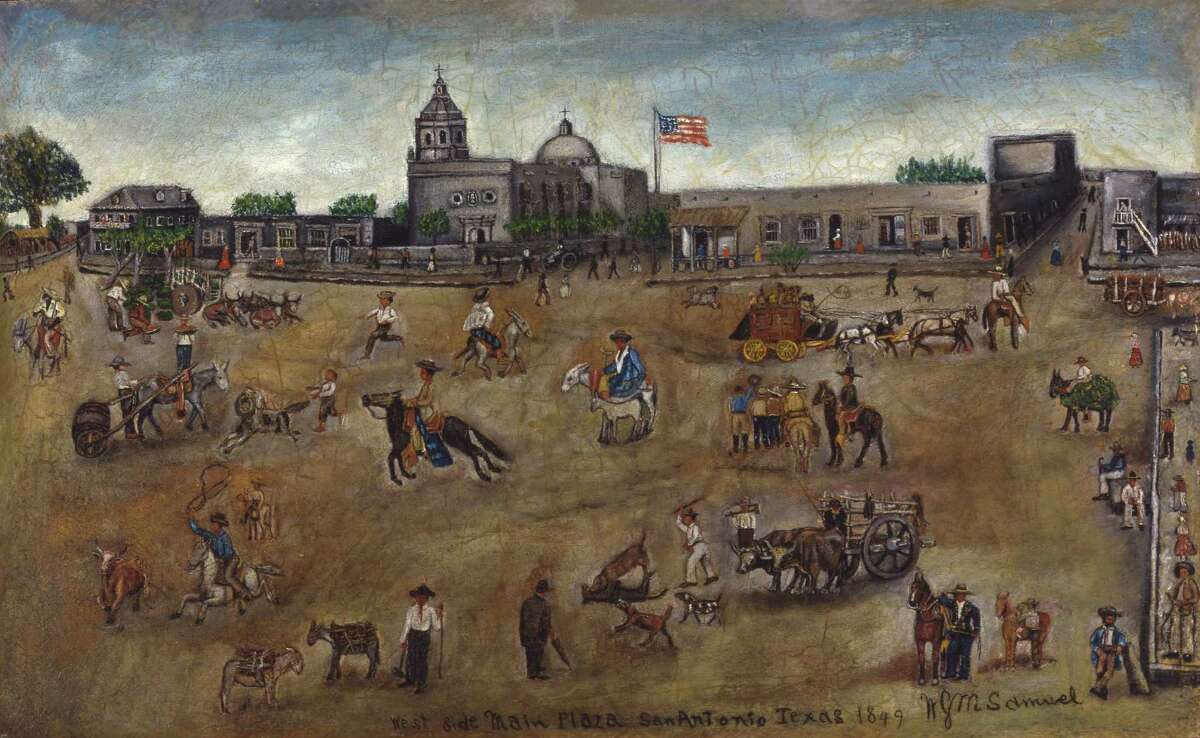
Though primarily known for its history and natural science exhibitions, the Witte Museum has an extensive art collection that includes work by early on Texas artists such as Theodore Gentilz and William Chiliad.M. Samuel.
Now with the opening of the two-story Robert J. and Helen C. Kleberg South Texas Heritage Center, the museum has a dedicated fine art gallery to show the works.
"The Art of a Wild and Vivid State," the inaugural exhibit in the Russell Loma Rodgers Texas Art Gallery located on the start floor of the centre, features artworks that are integrated every bit background graphics into "A Wild and Brilliant Country," the permanent exhibition upstairs.
While the drove "holds its own merely as art," it'due south also a valuable tool for telling the story of South Texas, says Amy Fulkerson, curator of collections at the museum. "One of the things that the Witte feels actually strongly about is using art for history'southward sake," she says.
"The Art of a Wild and Vivid Land" features paintings depicting the life and mural of Southward Texas, mainly between 1850 and 1950.
The show includes works by Gentilz, Samuel, Mary Bonner, Porfirio Salinas and Julian Onderdonk.
"We have over 3,000 pieces in our fine art collection and we'll be doing irresolute exhibitions of that collection within that space, so the theme volition alter," Fulkerson says.
"The Art of a Wild and Vivid Land" includes iii paintings by Gentilz, a Frenchman who came to South Texas in 1844 as an artist and surveyor for empresario Henri Castro, founder of the Castroville settlement. His "Sobre La Huella" ("On the Trail") depicts members of a flight company — precursors to the Texas Rangers — on an trek. The painting is intricately detailed, revealing particulars about the men'south clothes and gear, including the types of firearms they carried.
"He's near similar an illustrator in the clarity of his work," Fulkerson says. "In that location's a lot of history imbedded in what he represents."
Upstairs, Gentilz's "Comache Master" and "Comanches on the Warpath" are used equally background graphic fine art in an showroom area about the hostilities between plains Indians and early on settlers.
Meanwhile, Samuel's four views of Main Plaza offering a panoramic tableau of the town hub in 1849, humming with activeness. An untrained artist, the Missouri native who became a metropolis align painted in a naïve mode.
"Information technology is absolutely what we would call today exterior fine art," Fulkerson says.
Like Gentilz's work, Samuel'south paintings are packed with details.
"He had an office down on Principal Plaza, so this is what he saw exterior his window," Fulkerson says. "You tin can run across phase coaches (coming) and going, people bringing in goods to be sold. There's a lot of action happening."
Two of Samuel's views were blown up to landscape size to provide the backdrop for the exhibit area well-nigh Main Plaza.
"We could put an artifact in a example and we could give you a label, and tell you this whole long story," Fulkerson says. "Only when you fit in context, and you get to see what this artwork lends to information technology, information technology gives information technology a completely different dimension."
A piece past Thomas Allen painted between 1878 and 1879 depicts a scene in some other town hub, Market Plaza, located behind San Fernando Cathedral. The Boston-based creative person stopped in San Antonio during his travels through Texas and United mexican states.
The painting depicts Chili Queens disposed to customers seated at a long table in the hazy light of dusk. Nearby, chickens and a lone turkey scratch and nest in hay strewn on the basis.
"There's a larger version of this that he displayed at the Paris Salon," Fulkerson says. "And he did other views of this aforementioned marketplace. He actually seemed captivated by what was happening within this place."
The works past Salinas in the exhibit include pieces used to create a 168-by-15 pes digital composite mural upstairs.
"He definitely had a special talent," Fulkerson says. "You tin can look at (his work) and you lot get, 'OK, I see places like this around hither.' ... they really worked well for sort of setting the stage."
Outdoors, Gutzon Borglum'south "Trail Drivers Monument" has a new home in the courtyard in front of the center. Earlier it was relocated, the bronze by the sculptor who created Mount Rushmore stood outside the Pioneer Hall building.
The sculpture originally was a model for a forty-pes alpine monument that Borglum, who lived in San Antonio from 1924 to 1939, had proposed for the Municipal Auditorium. Information technology depicts cowboys on horseback driving a herd of cattle.
"It almost looks like they're driving the cattle toward the building," Fulkerson says. "It looks totally unlike in this garden than it did out forepart. It feels like a work of art."
lsilva@express-news.internet
Source: https://www.mysanantonio.com/life/article/Early-Texas-artists-have-new-home-at-Witte-3566874.php
0 Response to "Texas Art of Early Days to Now Witte Museum"
Post a Comment